Home » Excavator Damage Prevention Landing
Utility line markings are put in place to protect you and your crews when excavating…and to prevent damage to critical services. Understanding their importance is a key step to keeping your project on schedule and on budget. You can avoid costly mistakes and on-site delays by following safe digging practices, and that starts with contacting JULIE before you dig.
According to the Illinois Commerce Commission (ICC), the number 1 cause of excavation incident reports in Illinois is digging without a valid locate request, also known as a JULIE ticket. But there’s no reason to not contact JULIE—the process is easy!
Busy juggling multiple excavation projects? JULIE’s online application, Remote Ticket Entry (RTE), allows you to submit multiple locate requests at one time…helping you streamline the planning process. This convenient and FREE tool gives you more control and saves you time.
Have a single site or project to that needs to be marked? Submit an online locate request for FREE in minutes from your laptop or smart phone out in the field or in your office.
Simply call 811 or (800) 892-0123 and speak with a trained JULIE call center agent. Remember, the service is always FREE.
Contacting JULIE before you dig is just the beginning. It’s up to you and your crew to follow safe digging practices…every project, every time. In fact, failure to exercise due care is the second leading cause of excavation incident reports according to the ICC. This includes digging prior to verifying markings through potholing or hand digging, failing to maintain clearance after verifying markings, and improper excavation practices. Fortunately, it’s easy to reverse this trend by following these easy steps.
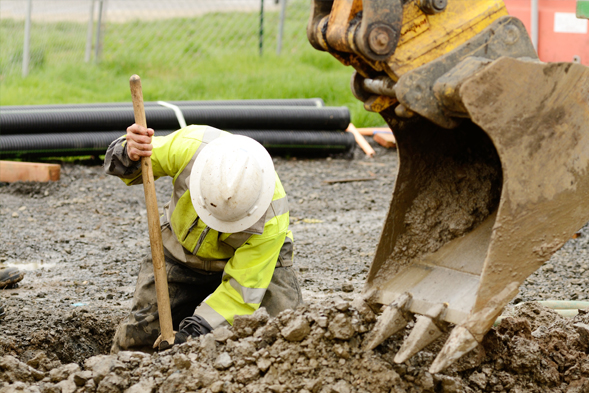
Before bringing in mechanized equipment, pothole or hand dig within 18 inches of both sides of the marked underground utility lines from the surface of the earth to the depth of the proposed excavation to prevent contact with buried utilities. This process of potholing or hand digging allows you to pinpoint the positions of various underground utility lines such as water, gas, electric, Internet, fiber optics, and more. The most common methods for potholing or hand digging are using shovels and hand tools, which is suitable for small projects or confined spaces, and vacuum excavation where high pressure water or air loosens the soil so it can be safely removed by a vacuum.
The Tolerance Zone is an area on both sides of underground utility line markings from the surface of the earth to the depth of the proposed excavation where mechanized digging is prohibited until all buried utilities have been exposed and protected. In Illinois, the Tolerance Zone is 18 inches on both sides of the underground utility line plus the diameter of the line or pipe itself if that information is provided. Avoid digging within this space whenever possible.
Rushing into digging without adhering to best practices for safety can lead to serious consequences beyond just striking a buried utility line. It can result in property damage, financial losses and more importantly it can cause injury and even fatalities to your crews. Some common improper excavation practices include ignoring utility line markings or digging within the Tolerance Zone, recklessly operating equipment near buried utility lines, and ignoring safety regulations and protocols such as those outlined by OSHA.
Striking a single underground utility line when excavating can disrupt critical services, shut down your project and endanger lives. Avoid these potential consequences by contacting JULIE before you dig…it’s the law! And always excavate responsibly.